
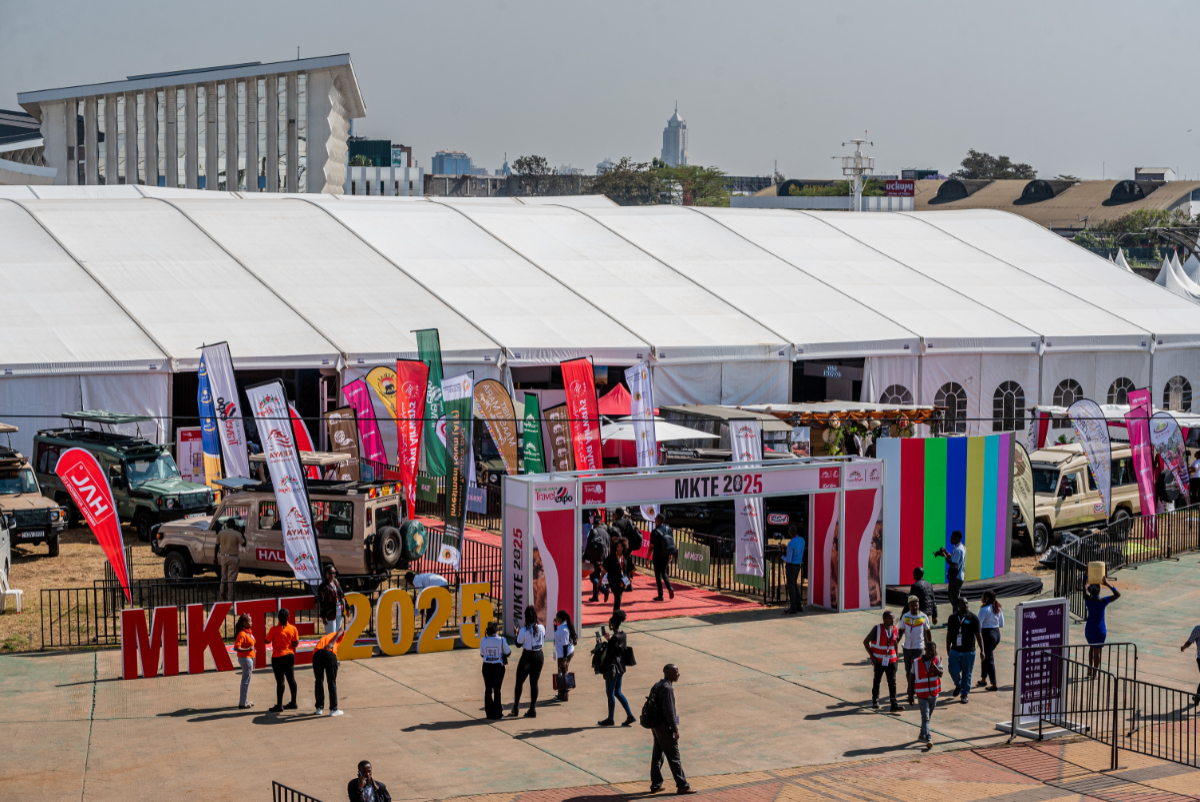
There is a particular sound that fills Uhuru Gardens every October. It is not one thing it is layered. Pitch conversations in six languages overlapping at adjacent stands. Laughter from the food court. The low hum of a hundred side conversations happening at once in the Buyers’ Lounge. Somewhere, a deal is being close. Somewhere else, a Maasai or Rwandese cultural performance is drawing a crowd three rows deep. This is the sound of an industry actually doing business with itself, in person, after a year of video calls and unanswered emails.
This is MKTE. And if you have only ever seen it from the outside a logo on a LinkedIn post, a stat in a recap deck you have missed the part that actually matters. The experience.
So, let’s walk through it. The thing itself, hour by hour, the way it actually happens.
The floor: where 350 stories are being told at once
|
DAY 1 |
Stepping onto the show floor
“The first ten minutes are always the same a kind of pleasant overwhelm.” |
| You walk in and the scale hits you before the detail does. Three hundred and fifty exhibitors, give or take, each one occupying a small stage for their corner of Kenya’s and Africa’s tourism story. A Laikipia conservancy with photographs that make you stop walking. A Mombasa beach resort handing out fresh fruit. A DMC from Kisumu with a screen looping drone footage of Lake Victoria at sunrise.
This is where product visibility becomes something real not a deck shared over email, but a conversation, a brochure in your hand, a sample of what the guest experience actually feels like. Exhibitors do not just display here. They demonstrate. New product launches happen on this floor, tested in real time against the reactions of the people who will actually sell them. |
Walk far enough and the floor starts to organize itself by instinct. Lodges cluster near other lodges. Airlines near ground handlers. Tourism boards from neighbouring countries end up trading notes two stands apart, the same way they would at any marketplace anywhere in the world proximity breeding conversation, conversation breeding partnership.
Speed networking: business, condensed
|
DAY 1–2 |
Eight minutes. One table. No small talk.
“This is where MKTE strips networking down to its most efficient form.” |
| Buyers and exhibitors sit across from each other in timed rotations eight minutes, sometimes less, enough for a sharp pitch, a real question, and an honest answer. A bell rings. You move to the next table. By the end of a session, a single exhibitor may have had structured conversations with a dozen buyers they would never have reached through cold outreach in a year of trying.
It sounds almost too simple to work. It works because everyone at the table has already been vetted. Buyers carry real purchasing authority. Exhibitors are there because their product matters. There is no wasted breath explaining who you are to someone who is not in a position to do business with you every single conversation in that room is, by design, a conversation worth having. |
“Speed networking did in ninety minutes what a normal sales cycle does in three months. I walked away with five qualified leads and two of them are now signed contracts.”
— Exhibitor, MKTE
The seminars: where the industry thinks out loud
|
ALL 3 DAYS |
Sessions that shape where this industry goes next
“Not panels for the sake of panels. Conversations that travel home with you.” |
| Between the floor and the lounges sit the seminar rooms, where industry experts lead sessions on the trends actually shaping African tourism right now sustainable tourism practices, market dynamics, emerging traveller behaviour, the conversations every serious operator needs to be part of. Exhibitors and buyers alike fill these rooms not out of obligation but because the insight is genuinely useful the kind of market intelligence that takes months to gather independently, delivered in fifty minutes by someone who lives inside the data.
This is also where thought leadership gets built in real time. The brands that speak from these stages do not just inform the room they position themselves as the names people remember when the floor closes and the contracts get signed. |
The Buyers’ Lounge: where the real conversations happen
|
ALL 3 DAYS |
A quieter room, a different kind of business
“Not every deal gets made on the floor. Some get made over a plate of food and a slower conversation.” |
| Step away from the noise of the main hall and you find the Buyers’ Lounge refreshments, lunch, reliable Wi-Fi, and senior decision-makers having the kind of unhurried conversation that the show floor rarely allows. This is where a scheduled thirty-minute meeting quietly becomes ninety minutes, where someone pulls out a laptop to sketch the outline of a partnership, where two people who were strangers an hour ago start using the word ‘we’.
If the floor is where MKTE introduces people to each other, the lounge is where it lets those introductions become something real. |
Curated experiences: Kenya, not explained but felt
|
THROUGHOUT |
The parts no brochure can capture
“MKTE does not just talk about Kenya’s magic. It puts it in front of you.” |
| Scattered through the three days are magical moments ranging from live cultural performances that draw a crowd mid-afternoon, tasting tables showcasing Kenyan coffee and cuisine, immersive showcases that let a buyer from Frankfurt or a trade visitor from Lagos experience, even briefly, the texture of what they are about to sell or source. For international buyers, fam trips extend this even further real days spent inside the lodges, conservancies, and coastal properties whose product they will be contracting before the expo even opens.
This is deliberate. The tourism industry sells experience. It only makes sense that the trade show built to grow that industry should let people feel it, not just hear about it. |
The food court: where the day exhales
|
ALL 3 DAYS |
Lunch is never just lunch at MKTE
“This is the unofficial meeting room nobody put on the programme.” |
| Somewhere between the structured meetings and the scheduled sessions, everyone ends up at the food court and it becomes its own kind of networking, looser and more human than anything on the agenda. A Kenyan tour operator trades notes with a Rwandan DMC over nyama choma. A first-time exhibitor, slightly overwhelmed by the morning, decompresses next to a buyer who turns out to be exactly the contact they were hoping to make. The best conversations at any trade show rarely happen in the meeting rooms. They happen here, with a plate of food between two people who were strangers twenty minutes earlier. |
The networking cocktail: where the day becomes a relationship
|
EVENING |
The room changes. So does the conversation.
“Take off the lanyard energy. Put on the actual humanity.” |
| When the floor closes and the lights shift, MKTE’s networking evenings open and something in the room changes. The pitches soften into stories. The business cards still get exchanged, but so do the personal ones: the lodge manager who tells you about the leopard sighting that changed how she sees her own property, the airline director who turns out to have grown up two streets from where you did. These are the exclusive events reserved for hosted buyers and delegates, designed deliberately to build the kind of relationships that outlast any single contract because the tourism industry, more than most, runs on people who genuinely like working with each other.
It is here, more often than anywhere else, that the seeds of next year’s biggest partnerships get planted. Not in a meeting room. At a cocktail table, with good food and better company. |
The dinner: where the industry sits down together
|
GALA EVENING |
The closing chapter, told around a table
“By the final dinner, strangers from Day 1 are old friends.” |
| There is a particular kind of warmth at the MKTE gala dinner that only comes from three days of shared experience. The people seated around you are not random they are the buyer you negotiated with on Day 1, the fellow exhibitor whose stand was next to yours, the speaker whose seminar gave you an idea you are still turning over in your head. Awards are given. Stories are swapped. And somewhere in the room, Kenya’s tourism story the one MKTE exists to tell gets told one more time, this time by the people who lived inside it for three days. |
Why this is the part nobody talks about and should
Most people describe MKTE in numbers. Exhibitors. Buyers. Square metres of floor space. And the numbers matter. But numbers do not explain why the same delegates come back year after year, why the relationships built here last for seasons, why a three-day trade show in Nairobi has become something closer to a homecoming for the people who work in African tourism.
What actually happens at MKTE is something simpler and harder to put in a stat box: people meet people. Strangers become suppliers become partners become friends, all inside seventy-two hours, all inside one venue, all because someone decided that the African tourism industry deserved a room built specifically for it to fall in love with itself again.
That is the experience. The floor, the speed networking, the seminars, the lounge, the cultural showcases, the food court, the cocktail evening, the dinner every one of these moments is doing the same quiet work. Turning contacts into contracts. Turning contracts into relationships. Turning relationships into the kind of industry that keeps Kenya, and Africa, at the centre of the world’s travel conversation.
MKTE 2026 runs 6–8 October at Uhuru Gardens, Nairobi. If you have only ever read about it, this is the year to feel it.
|
Be part of the experience — register for MKTE 2026 Exhibitors · Buyers · Trade Visitors · Media · Sponsors |