
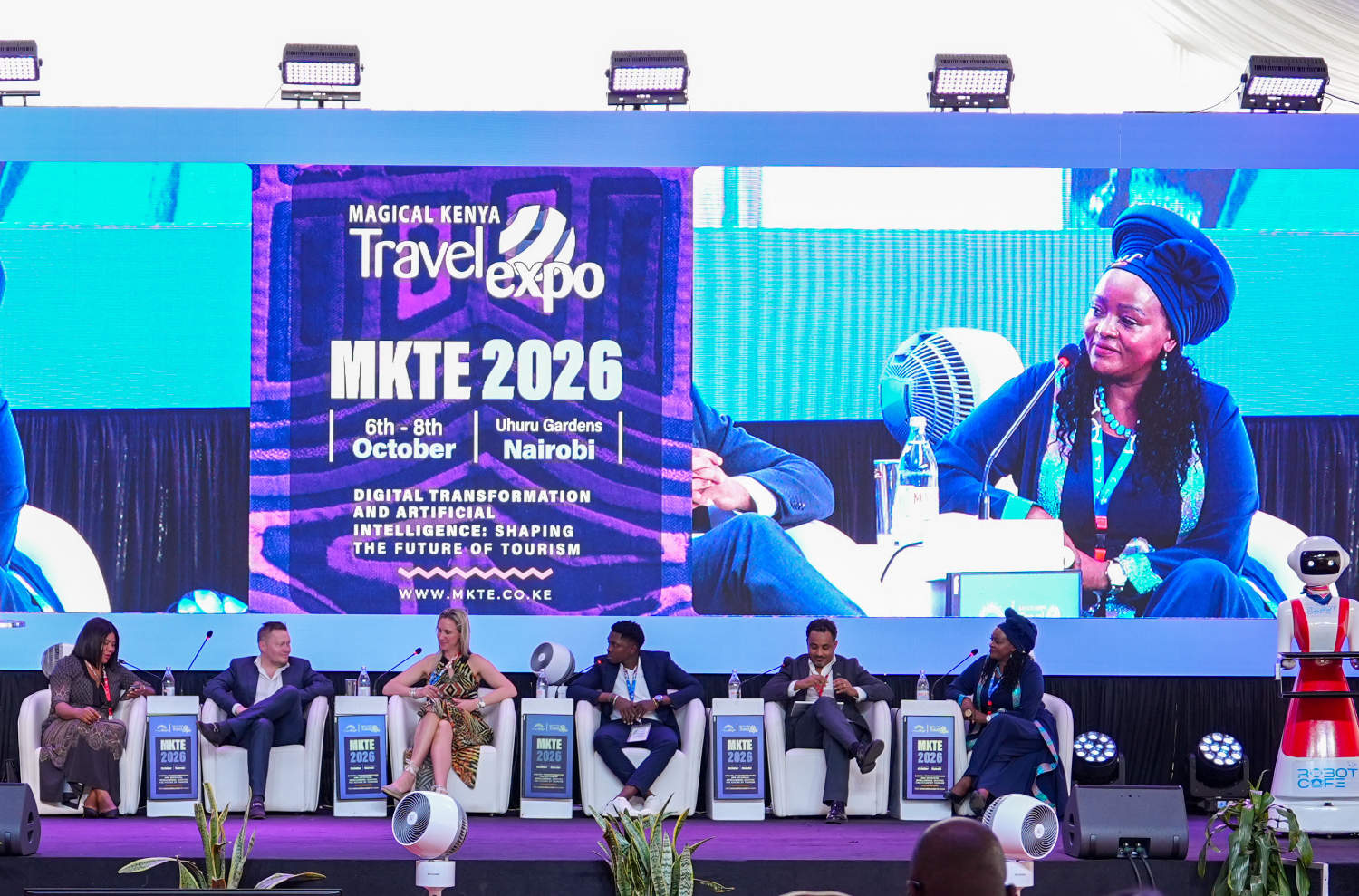
Twelve months ago we were at Uhuru Gardens. We came back, in Cabinet Secretary Rebecca Miano’s own words, bolder and with a clearer vision. The room on Wednesday morning felt exactly like that.
The official opening ceremony of the 16th Magical Kenya Travel Expo brought together Kenya’s tourism leadership, a Uganda government minister attending her first MKTE, two principal secretaries with very different but equally important portfolios, and a floor full of buyers, exhibitors and delegates who had been waiting since Tuesday to hear what the government’s tourism story was going to sound like this year. It did not disappoint.
| Beyond simply displaying tourism products, we are gathered here to shape the future of tourism itself. |
The CS Sets the Tone
Cabinet Secretary for Tourism and Wildlife Hon. Rebecca Miano, EGH, opened with context: global international arrivals surpassed 1.5 billion in 2025. Africa recorded 81 million. Kenya welcomed 2.7 million international visitors and earned KES 500 billion. Domestic travel hit an all-time high of 5.2 million trips. The numbers are real and the momentum behind them is deliberate.
But she was not here to read statistics. Her message was about where Kenya goes from here and what it takes to stay ahead in a travel market that is being reshaped faster than most of the sector has been willing to acknowledge.
The CS was direct about the opportunity: AI and data analytics can help identify emerging markets, personalise marketing, anticipate demand, improve service, and manage protected areas more intelligently. But she added a condition that most technology conversations skip over this transformation must democratise opportunity, not concentrate it. The small tour operator in a county town should have the same access to digital platforms as the large international company. That is the policy imperative sitting behind the technology conversation.
| Hon. Rebecca Miano, EGH
Cabinet Secretary, Ministry of Tourism and Wildlife “The next competitive advantage belongs to destinations that harness technology to understand travellers better, reach markets faster, craft smarter experiences, and manage destinations more sustainably. Thankfully, Kenya is ready for this conversation.” |
She challenged every person in the room buyer, exhibitor, investor, delegate to carry one question through the three days: what can we do differently and better to make Kenya and Africa more competitive in this next era of tourism? Then she declared MKTE 2026 officially open.
PS Bitok: The Capacity Question
Principal Secretary for Tourism Prof Julius Bitok picked up where the CS left off, and added a dimension the room did not expect.
The focus on AI, technology and digital transformation at this year’s expo is timely, he said, because these tools are actively driving Kenya’s numbers upward not in theory, in practice. But then he raised the next question, the one the sector needs to start answering now: do we have the capacity and infrastructure to handle what is coming?
The example he used was striking. Next year Kenya hosts AFCON. The expectation is one million attendees. One million. Does the country have the accommodation, the transport, the digital systems, the service capacity to deliver a world-class experience at that scale? The government is working with industry stakeholders to build that capacity, he said. But the question itself is worth sitting with for a moment because it shifts the conversation from ambition to readiness.
PS Bitok also addressed something that international buyers in any room need to hear stated plainly and from authority: Kenya is safe, secure, and ready to host the world. No qualifications, no caveats. An assurance.
| Prof Julius Bitok
Principal Secretary, State Department for Tourism “AI, technology and digital transformation are not future conversations for Kenya. They are actively driving our numbers upward right now.” |
PS Musieya: The Communities Question
Principal Secretary for Wildlife Silvia Musieya brought a different register to the ceremony and it was one the audience needed to hear alongside the technology and growth narrative.
Tourism success that does not reach the ground that does not translate into real benefit for the communities living alongside Kenya’s wildlife, coastlines and natural heritage is not success. It is extraction. The PS was clear that sustainable conservation and tourism are most powerful when the grassroots communities who live with and manage Kenya’s natural assets are fully integrated into the value chain and experience the benefits of growth firsthand. As the numbers go up, the question of who captures that growth has to go up alongside them.
| Sustainable conservation and tourism are most powerful when grassroots communities are fully integrated and experience the benefits firsthand. |
Uganda’s Minister: Africa Is Not a Collection of Competitors
The most unexpected energy in the ceremony came from Uganda.
Hon. Susan Nakawuki Nsambu, State Minister for Tourism, Wildlife and Antiquities of Uganda, was attending her first Magical Kenya Travel Expo. She said Kenya felt like a home away from home, which landed warmly in the room. But her actual message was sharper than hospitality.
Uganda and Kenya are not competitors. They are permanent partners. And the continent as a whole is stronger when it markets itself as a single destination rather than as forty-plus countries individually pitching for the same traveller’s budget. She called on policymakers to break down non-tariff barriers, improve intra-African connectivity, and reduce the time and cost of travelling within the continent. She noted that tourists who visit one East African country typically leave with some of their travel budget unspent and that budget goes to the next destination if the region is packaged properly.
She acknowledged the cross-border cultural ties that already exist Nyege Nyege was her example, the Ugandan music festival that draws Kenyan attendees in numbers, and the kind of organic regional connection that formal tourism policy is still trying to catch up with.
| Hon. Susan Nakawuki Nsambu
State Minister for Tourism, Wildlife and Antiquities, Uganda “Uganda and Kenya are not competitors. We are permanent partners. True growth comes when we market Africa as one — because we are one.” |
What does this mean?
Kenya has the numbers and the momentum. The sector is growing, the government is investing, and the platform to accelerate that growth is right here at Uhuru Gardens. That much was clear from the CS and the CEO’s briefings.
But the opening ceremony added texture to the growth story. PS Bitok asked whether the infrastructure can carry the ambition. PS Musieya asked whether the communities on the ground can feel the growth. Uganda’s minister asked whether Africa is willing to stop competing with itself long enough to capture the full potential of what the continent has to offer.
Those are not cautionary notes. They are the questions that distinguish a tourism sector that is building something durable from one that is riding a cycle. MKTE 2026’s seminar programme is built around exactly these tensions between technology and inclusion, between scale and sustainability, between national positioning and regional collaboration.
The floor is open. The sessions are running. The conversations have moved from the stage to the exhibition stands and the meeting rooms. That is the point.
| Connections that become partnerships. Conversations that become investments. Ideas that become innovations. Opportunities that become enterprise. |
|
MKTE 2026 CONTINUES TODAY — THURSDAY 8 OCTOBER Creator Summit · Tourism Resilience Session · Creative Economy Seminar Full programme: www.mkte.co.ke/seminar-topics-speakers-panelists Uhuru Gardens, Nairobi · #MKTE2026 · #MagicalKenya · #AfricasConnectionHub |